When to Use RAG vs Simple Search: A Practical Decision Guide
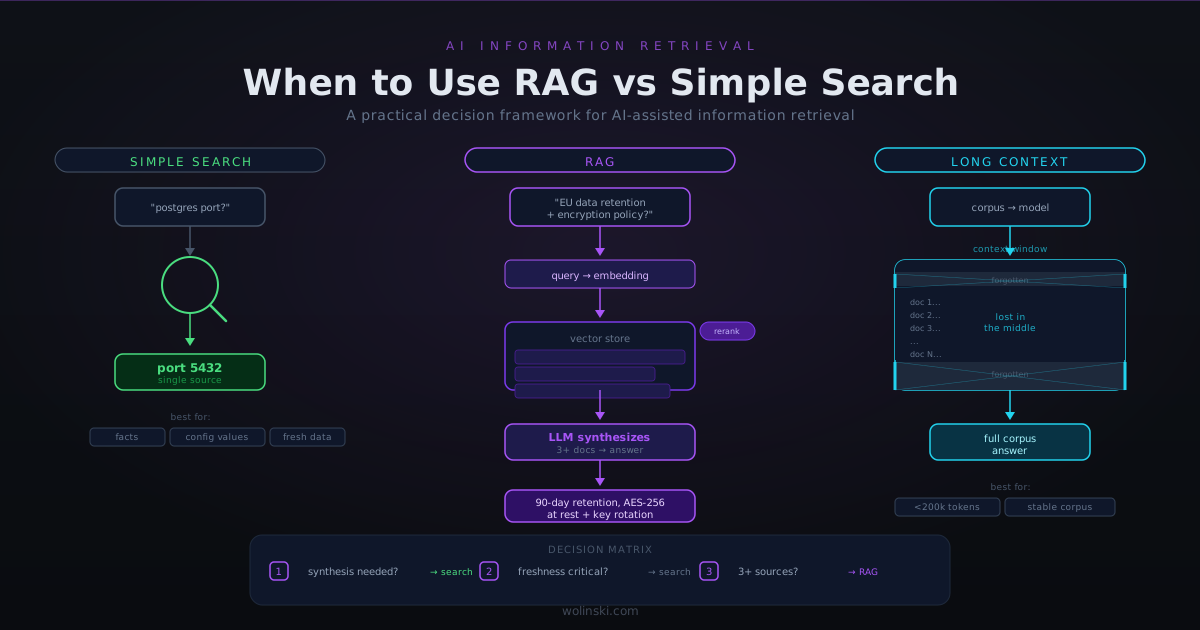
You have a question about your company's codebase. You have three ways to get an answer: paste the question into a search engine, give an AI the relevant documents and ask it to synthesize, or — if your corpus fits in the context window — drop the entire corpus into the model and ask directly. Most of the time, the first option is faster and more reliable. Sometimes — surprisingly often — the other two are overkill.
The choice between retrieval-based and RAG-based answers is a decision most AI practitioners make badly, usually by defaulting to RAG because it sounds more sophisticated. Long-context models add a third option that is equally easy to reach for and equally easy to misuse. This article gives you the actual decision criteria.
What RAG Actually Does
RAG stands for Retrieval-Augmented Generation. The name says exactly what it does: you retrieve relevant documents, then hand them to a language model as context for generating an answer. The LLM does not know these documents — it sees them only in this conversation. The retrieval step is what decides whether the answer is grounded in reality or hallucinated.
Without retrieval, an LLM answers from its training data. It is a static snapshot of the world from when it was trained. If your question is about something that changed after that date, or is specific to your data that was never in any training set, the answer will be confidently wrong.
Retrieval closes that gap — but it introduces its own complexity. You need an embedding model, a vector store, a way to chunk documents, a retrieval strategy that does not drop the most relevant information, and a prompting approach that tells the model how to use what it receives. Each of those steps is a source of failure.
When Simple Search Wins
Most questions have a single, stable, authoritative answer that lives in one place. The question is how to find that place, not how to synthesize information across sources.
Consider: you need to know what port PostgreSQL runs on. You search "postgres default port". You get port 5432. You are done. The answer is not inside a document that needs to be summarized — it is the document.
Or: you have a specific error message and you need the specific fix. StackOverflow, GitHub issues, vendor documentation. You read the answer, apply it, move on.
These are retrieval problems. The answer exists somewhere. The challenge is locating it. A semantic search engine — or even a full-text search — handles this perfectly. Adding an LLM on top adds latency, cost, and a new failure mode for no benefit.
Simple search also wins when:
- The answer is a number, a command, a configuration value
- Freshness matters — you need the absolute latest version of a document
- You are building a tool for users who need to browse and explore, not just ask questions
- The question is navigational — the user knows roughly where the answer lives
Note: well-implemented RAG systems provide citations too — this is not a fundamental advantage of simple search, it is a function of implementation quality.
When RAG Is Worth It
RAG earns its complexity in one specific scenario: when the question requires synthesis across multiple documents, and the relevant documents are too large or too unstructured for a human to locate manually in reasonable time.
You have 200 internal documents about your product, your customers, your infrastructure, and your processes. Someone asks: "What's the current status of our data retention policy for EU customers, and how does it interact with our encryption at rest setup?" That question does not map to a single document. The answer is scattered across three documents, none of which has the complete picture.
A human reads all three, synthesizes, and answers in ten minutes. A RAG system does the same in seconds. The value is not in having AI — it is in having AI do the synthesis work that previously required a human expert who knew where to look.
RAG also matters when:
- The documents are semi-structured — meeting notes, Slack threads, design docs — where exact keyword matches miss relevant context
- The question is open-ended and the right answer depends on judgment, not just fact lookup
Handling complex multi-hop questions. Some questions require information from multiple locations that do not overlap semantically. The example above — "What's the current status of our data retention policy for EU customers, and how does it interact with our encryption at rest setup?" — a single query embedding searches for one concept but the question contains two. A single query often retrieves poorly because neither half is sufficient on its own. Two techniques help: query decomposition breaks the question into sub-queries (one for retention policy, one for encryption at rest), runs each independently, then synthesizes the results. HyDE (Hypothetical Document Embeddings) generates a hypothetical answer first, embeds that instead of the raw question, and uses the embedding to retrieve real documents that match the expected answer structure. Both are especially useful for multi-hop questions where the connections between topics are not obvious from the query alone.
When the Whole Corpus Fits
There is a third option that the binary framing of this article has been hiding — and it is increasingly viable.
With context windows of 1M+ tokens in current frontier models and prompt caching that brings repeated context costs close to zero after the first call, for moderate corpus sizes — hundreds of documents, not millions — you can drop the entire corpus into the model and ask directly. No embeddings. No vector store. No chunking. No retrieval errors.
This is not a niche scenario. A codebase of 500 documents at average technical documentation size is comfortably under the context limit of most frontier models. The architecture becomes trivially simple: read all documents into context, ask the question.
The appeal is real — long context eliminates an entire class of failure modes. Retrieval cannot miss what it never had to find. Chunking cannot destroy the surrounding context. There is nothing to tune.
But it moves the cost somewhere else. Lost in the middle — the positional bias problem covered earlier in this article — does not disappear with larger context. Liu et al.'s research shows the phenomenon persists at different context lengths, not that it intensifies proportionally. What changes is that a larger window accommodates more documents competing for position, increasing the probability that any given document lands in the underweighted zone. That is a difference in probability of failure, not in the severity of the positional bias per se.
Long context also pays per-query pricing on the full context, not just the retrieved subset. Prompt caching amortizes the cost of repeated context, but the first call and any novel additions are not free. For high-frequency query patterns, a well-tuned RAG system that retrieves 5 chunks per query will be cheaper than stuffing 500 documents every time.
Use long context when:
- The corpus is well below the hard technical limit — 200k here is a safety margin that accounts for the positional bias problem, leaving headroom so no document lands in the forgotten zone
- Prompt caching is available and covers your query patterns
- You want zero operational complexity — no embeddings pipeline, no vector store to maintain
Use RAG when the corpus is large (millions of tokens), changes frequently, or when you need cost efficiency at high query volume. The trade-off is not about sophistication — it is about where you want to carry your complexity: in retrieval precision and chunking quality (RAG), or in positional bias and context management (long context).
Agentic Retrieval: When the Model Decides
Both approaches above assume a static architectural decision — you, as the system designer, choose upfront whether a given query gets retrieval or not. That assumption does not hold in modern agentic systems.
In a ReAct-style agent, the model receives a user question and decides at runtime whether to call retrieval, based on what it already knows and what it still needs. A factual lookup question — "what's the current version of Node.js?" — the model answers directly from its training data. A question about your company's internal architecture from last quarter — it triggers a retrieval call. The same model, the same request, different behaviour depending on the question.
This shifts the decision problem from "which system do I use" to "what instructions do I give the agent." You define the boundaries: when does the model know enough to answer, when does it need to retrieve, and what permissions does it have when it does. Retrieval becomes a tool the agent calls on demand, not a pipeline you run for every query.
The practical implication: if you are building an AI assistant over internal documents, consider whether you are designing a retrieval pipeline or an agent. The difference matters for latency (agents only retrieve when needed), cost (you do not pay for synthesis on every query), and user experience (fast direct answers vs. slower synthesized responses).
The Decision Matrix
Answer these questions in order:
1. Does the question require synthesis across multiple sources?
If no — use simple search. Finding one fact in one place is not a synthesis problem.
If yes — proceed to question 2.
2. Is freshness critical?
If you need the absolute latest version of documents, a vector store built yesterday may already be stale. Either use a real-time retrieval layer on top of RAG, or accept the tradeoff. If freshness is not a concern — proceed to question 3.
3. Is the answer expected to come from a single source, or multiple competing sources?
If one authoritative source — a RAG system can retrieve that source efficiently, but you pay extra for synthesis you do not need. Consider whether a direct link to the document is more useful than a generated answer.
If multiple sources, conflicting data, or unclear which source is authoritative — RAG earns its complexity. Synthesis across sources with unknown relative authority is exactly what it is designed for.
Most RAG deployments fail because someone built a sophisticated system to answer "What's our vacation policy?" — a question that lives in one HR document, does not require synthesis, and changes frequently. The vector store is stale, the answer is wrong, and now you have two problems instead of one.
Failure Modes That Tip the Balance
Simple search fails when the relevant information is spread across too many sources for a human to assemble in reasonable time, or when keyword-based search misses relevant content because it uses different vocabulary than the query.
RAG fails when the retrieval step misses the most relevant documents (wrong embedding model, poor chunking, bad top-k), when the documents are outdated, or when the question requires precise facts that chunking destroys the context for.
Enterprise-specific failure: permission-aware retrieval. In production RAG over internal company data, you almost always have documents with different access levels — financial reports visible only to leadership, HR files restricted to specific teams, customer data that cannot be exposed externally. A naive RAG system retrieves all relevant documents and hands them to the LLM for synthesis — regardless of whether the user asking the question has clearance to see that content.
The LLM does not know about your access control layer. If it sees a restricted document in the context window, it may include information from it in the answer. The fix is to enforce access control at retrieval time, not at generation time: the vector store query returns only documents the current user is authorized to see. This requires storing document-level permissions alongside embeddings, and filtering results before they reach the synthesis step. It is the difference between a RAG demo and a production system you can actually ship.
A good rule: if a human with domain knowledge can find the answer in under two minutes with a good search engine, do not use RAG. If it would take ten minutes of reading across multiple documents, RAG earns its cost.
The Hybrid Path
In practice, the best systems combine both. A simple search step first — find candidate documents. Then a RAG step over those candidates — synthesize the answer. This is what Perplexity does for web search, and what good internal knowledge systems do for enterprise data.
The architecture looks like this:
# 1. Fast keyword/semantic search — narrow to top N candidates
curl -X POST "https://search-api.internal/search" \
  -d '{"query": "EU data retention encryption", "limit": 5}'

# 2. Pass retrieved docs to LLM for synthesis
curl -X POST "https://llm-api.internal/generate" \
  -H "Authorization: Bearer $LLM_KEY" \
  -d '{
    "prompt": "Based on these documents, answer: what is our data retention policy for EU customers?",
    "context": [...retrieved_documents]
  }'
The search step gives you recall — you find the relevant documents. The generation step gives you precision — the LLM extracts and synthesizes the answer from what was found.
The second step can be disabled for questions that look like fact lookups, and enabled only for open-ended synthesis questions. That way you do not pay the latency and cost of generation for questions that do not need it.
Practical Implementation Notes
If you build a RAG system, three decisions determine most of the quality:
Chunking strategy. Chunks that are too small lose surrounding context. Chunks that are too large include irrelevant information that dilutes the signal. For technical documentation, 500-1000 tokens with 50-token overlap between chunks is a reasonable starting point. For conversational context (meeting notes, Slack), larger chunks preserve more thread-level context.
Embedding model. General-purpose embeddings (OpenAI text-embedding-3, Cohere embed) work for most cases. If your domain uses specialized vocabulary that general models do not handle well, a fine-tuned domain-specific embedding model is worth the investment.
One operational consideration to settle before you commit: changing the embedding model later requires re-embedding the entire corpus from scratch. Embeddings live in vector space — old and new embeddings are not comparable, they live in different spaces. If you switch from OpenAI to Cohere embeddings, the old vectors are garbage. Re-embedding means recomputing every document, which costs money and time, and during the migration you are either running dual-write or accepting a period of degraded retrieval quality. Choose the embedding model thoughtfully on day one. If you anticipate needing to switch, design the pipeline so re-embedding is a scripted operation, not an architectural problem.
Retrieval evaluation. You cannot improve what you do not measure. Start with hit rate — does the relevant document appear in top-k? — and use a small set of representative Q&A pairs to establish a baseline before changing anything.
But hit rate is only the first metric. Groundedness (also called faithfulness) measures whether the generated answer actually stays within what the retrieved documents say — it catches the case where retrieval succeeds but the LLM ignores the context and confabulates anyway. Even perfect retrieval does not guarantee grounded output.
Production monitoring. A one-time baseline measurement is not a production system — it is a snapshot. Retrieval quality drifts over time as new documents are added (with different vocabulary and structure), as query patterns shift, and as the embedding model ages relative to the data it indexes. Build monitoring into the system from the start: log every query with its retrieved context and the generated answer. Periodically run the evaluation set against the live system to catch degradation before users report it. For high-stakes deployments, A/B test chunking strategies, reranking configurations, and embedding model candidates on a fraction of live traffic — small changes in retrieval quality compound across thousands of queries.
Then there is lost in the middle — a documented phenomenon where LLMs underutilize information from the centre of a long context window. They weight the beginning and end of a context more heavily, and information in between gets lost. The practical implication from Liu et al.'s research is ordering: sort the retrieved chunks so that the most relevant ones land at the beginning or end of the context window sent to the model, not buried in the middle. Keep context windows lean rather than dumping everything in — the model already struggles with volume on top of positional bias.
Reranking. The first retrieval pass uses a fast bi-encoder to surface top-k candidates. A second pass runs a cross-encoder that re-scores those candidates with full query-document attention — slower, but dramatically more precise. For production systems where top-k precision matters, this two-stage approach is the standard. Models like Cohere Rerank or BAAI bge-reranker serve this purpose.
Hybrid search. Pure embedding-based retrieval often misses exact keyword matches — proper nouns, version numbers, code identifiers. A hybrid approach combines dense embeddings with sparse keyword search (BM25) and merges the scores. This handles both semantic similarity and exact term matches, which is especially important in technical documentation where exact terminology is often the only reliable signal.
Summary
Three architectural options, each with its own trade-offs. Simple search: questions with a single authoritative source — fast, precise, verifiable, cheap. RAG: questions requiring synthesis across multiple documents — slower, more expensive, harder to debug, but capable of answering questions no single document can answer alone. Long context: moderate-sized corpora where you can drop the entire corpus into the model — no embeddings pipeline to maintain, but positional bias moves the failure mode rather than eliminating it.
The failure mode to avoid is using RAG by default because it sounds advanced. The failure mode to avoid on the other side is dismissing RAG entirely because "simple search works for most things." The right question is not which is better, but which is correct for this specific question, this specific corpus size, this specific query frequency.