What Is Process Orchestration? A Definition You Can Test, on Camunda 8 and Temporal

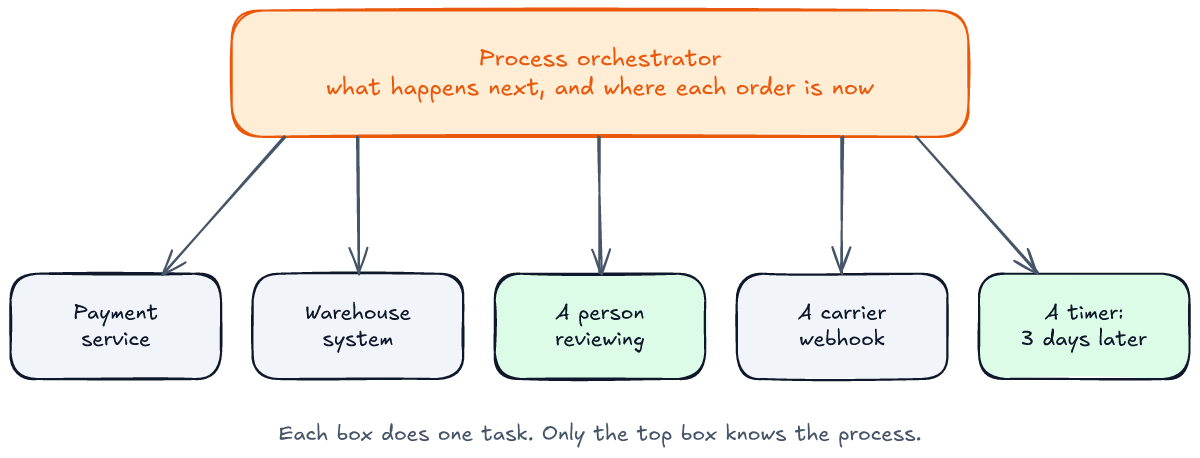
Process orchestration is coordinating the steps of a long-running business process from one place: a component that decides what happens next, remembers where every running case is, and survives the crash of anything it calls. The steps may be services, people, external systems or plain waiting. The orchestrator does none of that work itself. Its job is the order of the work and the memory of it.
That is the definition I will defend here, and I will do it by experiment, because many explanations of the term come from companies selling it. I built one order process four ways: as a plain method, as events between services on RabbitMQ, on Camunda 8 and on Temporal. Then I killed things, with no chance to clean up, and watched what each one remembered.
Three results surprised me enough to mention now. Choreography survives a worker crash just as well as an engine does, so resilience is not the reason to orchestrate. Engines do not give you exactly-once: the same crash charged a card twice on all three designs that retry. And Camunda's default job polling cost more than ten times the latency of its streaming mode, on one flag.
Everything is in the companion repository. Every block of source below is a real file there, and its first line says which one. Claims about behaviour are backed by its 33 tests, which run against real engines in Docker. Where I rely on documentation alone, the text says so.
A definition you can test
Camunda, which sells this, defines it as "the coordination of the tasks that make up a process, both automated and manual", and separates it from task automation, which handles individual tasks without coordinating a larger process. That is a fair start, but it does not help you decide whether a given system qualifies. Here is a version that does. Something orchestrates a process if it has all four of these:
- The process is written down in one place. You can read the order of the steps without reading every service.
- The progress outlives the code. Kill any worker, or the engine itself, and each case continues from its step.
- Waiting is cheap. A case can wait three days for a person or a parcel with nothing of yours required to stay running.
- You can ask where a case is, and when one is stuck, the answer says so.
What it is not
The word is overloaded.
| the other thing | what it coordinates | how it differs |
|---|---|---|
| Container orchestration (Kubernetes) | Where programs run | It keeps processes alive. It knows nothing about order A-17. |
| Data pipeline orchestration (Airflow) | Batch jobs over data | Usually runs on a schedule over a dataset, not per business case waiting on a person. |
| Task automation, RPA | One task | It does the work. Something else has to decide when. |
| Agent orchestration | LLM calls and tools | A model picks the next step at run time. A process has its steps written down, and I covered how to choose between them separately. |
"Workflow orchestration" and "workflow automation" are mostly the same idea under other names, and vendors do not use them consistently. Camunda calls process automation "a mix of process orchestration and task automation". I would not build an argument on the difference. Business process management (BPM) is older and wider: a management discipline that may or may not involve an engine.
Analysts have their own label as well. Gartner now groups these products with low-code and integration tools as business orchestration and automation technologies, or BOAT. You will see it on vendor pages. It describes a product market, not an engineering technique.
The vocabulary
| term | what it means |
|---|---|
| process definition | The written-down steps: a BPMN file, or workflow code. |
| process instance | One running case, such as order A-17. Temporal calls this a workflow execution. |
| BPMN | Business Process Model and Notation, a standard for drawing processes that an engine can also run. |
| job, worker | A job is one unit of work the engine hands out. A worker is your code that takes jobs and reports back. Temporal says activity. |
| incident | Camunda's record that an instance is stuck and needs a human. |
| correlation | Matching an incoming event to the instance waiting for it, usually by a business key. |
| compensation | A step that undoes the business effect of an earlier one, such as a refund. |
| saga | A long business transaction made of local steps with compensations instead of a rollback. |
| choreography | The same process with no coordinator: services react to each other's events. |
| durable execution | Running ordinary code so that its progress survives a crash, by recording and replaying history. |
| idempotent | Safe to repeat: doing it twice leaves the same result as doing it once. |
The process, and the obvious way to write it
A shop charges a card, reserves stock, ships, and waits for delivery. Large orders need a person to look at them. If there is no stock, the money goes back. If the parcel is late, someone chases the carrier.
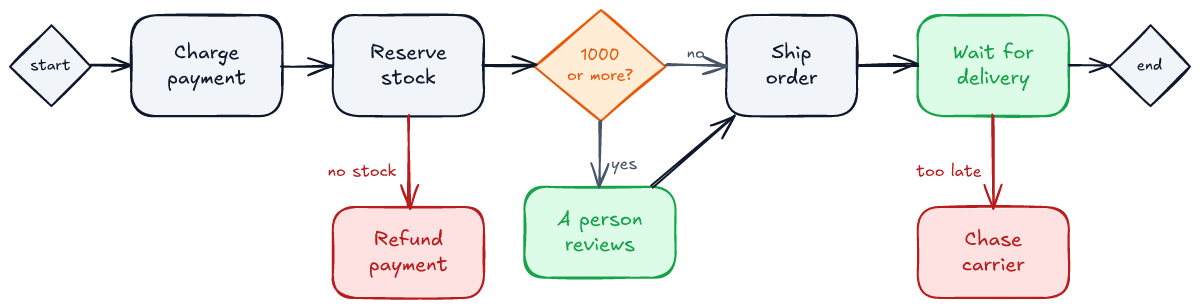
Here is the happy path as code, the way most of us would start:
// src/main/java/com/wolinski/orchestration/plain/PlainCheckout.java
public void place(String order) {
    payments.chargeBlindly(order);
    crashHere();
    effects.record("reserve:" + order);
    effects.record("ship:" + order);
}
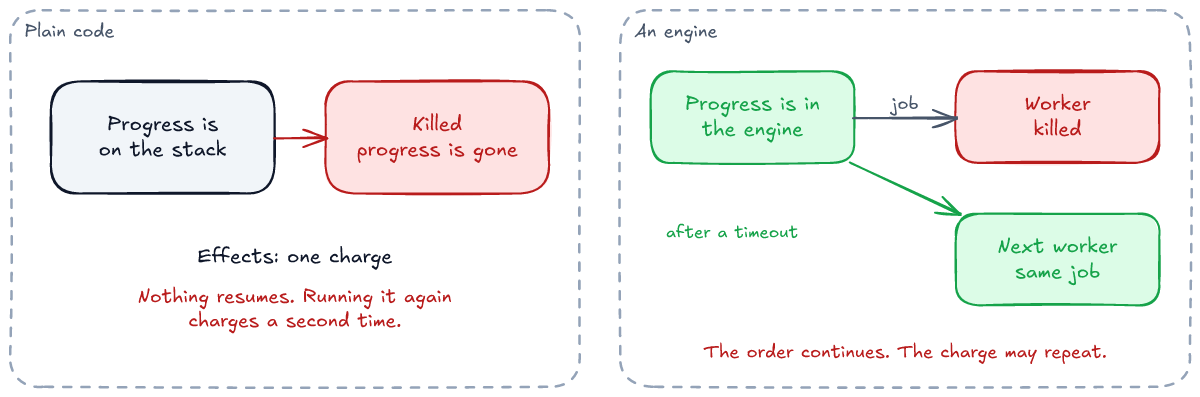
crashHere is the test's switch. I ran this in its own JVM and halted it right after the charge. The log of what really happened in the world reads charge:P-1, and that is all. Nothing knows the order is half done, because all the progress was on a stack that no longer exists. Running it again gives charge, charge, reserve, ship.
You can fix this, and teams do. Add a status column. Add a scheduler that picks up rows stuck in CHARGED. Add a lock so two schedulers do not take the same row, then a retry count, then a timeout, then a dead-letter state, then a screen for support. I wrote about exactly this for an outbox relay, and it took 7,000 words. At the end of that road you own a small process engine, one that handles one process. That is a reasonable outcome for one process. It is a poor one for the tenth.
How an engine works
An engine splits the method above in two. The order of the steps moves into a definition, and the state moves into the engine's durable storage. Your code keeps only the steps themselves. Here is one step in BPMN, with the failure path attached to it:
<!-- src/main/resources/bpmn/order.bpmn -->
<bpmn:serviceTask id="reserve" name="Reserve stock">
  <bpmn:extensionElements>
    <zeebe:taskDefinition type="reserve-stock" retries="3" />
  </bpmn:extensionElements>
</bpmn:serviceTask>
<bpmn:boundaryEvent id="no-stock" name="Out of stock" attachedToRef="reserve">
  <bpmn:errorEventDefinition errorRef="out-of-stock" />
</bpmn:boundaryEvent>
The standard part says "a service task, with an error path". The zeebe: part is Camunda's extension that names the job, so a file like this is not portable between engines as it stands. And here is the worker, which pulls jobs of that type and knows nothing about what comes before or after:
// src/main/java/com/wolinski/orchestration/camunda/OrderWorkers.java
worker("reserve-stock", (jobs, job) -> {
    String order = orderOf(job.getVariablesAsMap());
    if (Boolean.TRUE.equals(job.getVariablesAsMap().get("outOfStock"))) {
        jobs.newThrowErrorCommand(job).errorCode("OUT_OF_STOCK").send().join();
        return;
    }
    effects.record("reserve:" + order);
    jobs.newCompleteCommand(job).send().join();
}),
The loop is the same on both engines here. The engine reaches a step and creates a job. A worker takes it, does the work and reports back. The engine records that, works out the next step, and repeats. Between those moments nothing of yours has to be running.
What you get, tested
All of this ran on Camunda 8.10.8, with Temporal 1.40.0 giving the same results wherever a row names both.
| scenario | what happened |
|---|---|
| No worker running | The instance waits at its step. Start a worker later and it carries on. |
| Worker killed while the order waits (Temporal) | A new worker carries on, and finished steps do not repeat. |
| Engine killed mid-process (both) | After a restart, the instance is at the same step, with its variables, and charges and shipments do not repeat. |
| A 15-second timer, with the engine down at the deadline (both) | It does not fire while the engine is down, and fires once after the restart. |
| Out of stock (both) | The error path runs the refund. Nothing ships. |
| Order of 1000 or more | Waits for a user task and ships once it is completed. |
| Carrier API down, retries used up | An incident naming the step and the error. The instance stays put until someone updates the retries and resolves it, then carries on. |
The incident row deserves a second look, since it is the fourth property from the definition. The test finds the instance from the order number A-7, through a search on its variables, and gets back ship with the error text carrier API is down. That is the answer support has wanted all along. On Temporal the same lookup is simply the workflow ID, if you set it to the order number. Two caveats. An incident sits there until someone looks, so it needs an alert like anything else. And on Camunda those queries read a copy that is exported from the engine's log, so my tests poll for the answer rather than assuming it is there at once.
What you do not get
This section is the reason I wrote the article.
Exactly-once
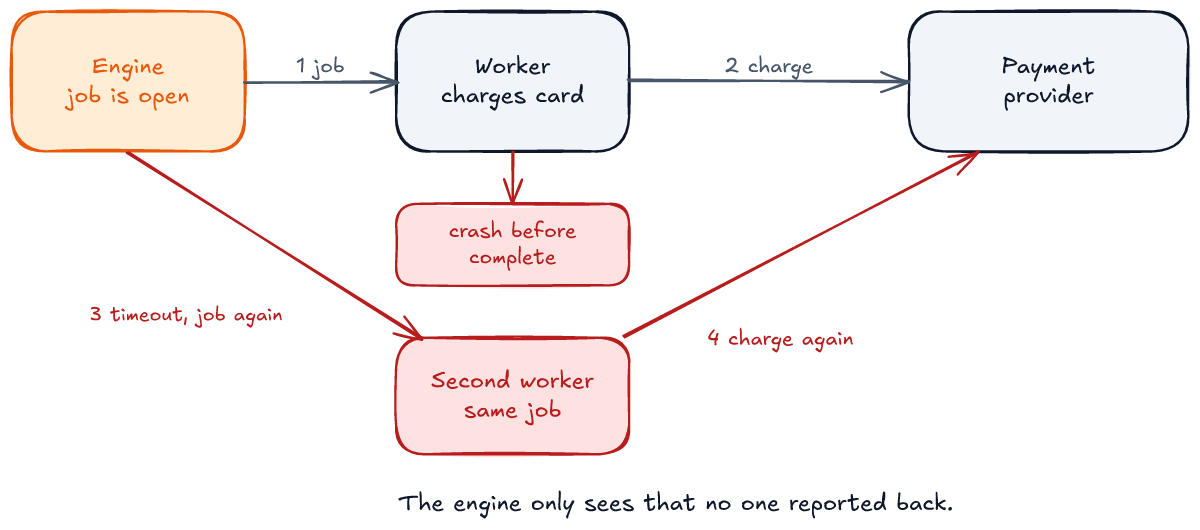
I killed a worker after it charged the card and before it reported back:
// src/test/java/com/wolinski/orchestration/CamundaTest.java
// The last two arguments: idempotent = false, crash after charging = true.
Process dying = Jvm.start(List.of(), WorkerMain.class,
        engine.grpc().toString(), engine.rest().toString(), effects.file().toString(), "false", "true");
long instance = startOrder("A-3", Map.of());

assertThat(dying.waitFor()).isEqualTo(137);
assertThat(effects.count("charge:A-3")).isEqualTo(1);

Process healthy = Jvm.start(List.of(), WorkerMain.class,
        engine.grpc().toString(), engine.rest().toString(), effects.file().toString(), "false", "false");
try {
    awaitAt(instance, "wait-delivered");
    assertThat(effects.count("charge:A-3")).isEqualTo(2);
} finally {
    healthy.destroyForcibly().waitFor();
}
That test passes, which means the card was charged twice. Temporal did the same, and so did the RabbitMQ version. It is not a defect in any of them.
Both vendors say so. Camunda's guide on workers warns: "Your workers must be idempotent." Temporal's docs on activities recommend "that it be idempotent, so retries can be processed without duplicate side effects". The fix belongs on the side effect: pass a key the provider deduplicates on, or, for your own consumers, keep an inbox.
// src/main/java/com/wolinski/orchestration/camunda/OrderWorkers.java
payments.charge(order, "charge-" + order);
With that line the same crash charges once. The key is the order number on purpose. My first version used the process instance key, which looked tidier and has a hole in it: a duplicate instance gets a different key, and the next section shows how easily you get one.
A worker crash is not even required. If the engine goes down between the charge and the report, the report fails, and the job runs again after the restart: two charges, and no worker crashed. And a job that takes longer than its timeout is handed out again while the first run is still going, which a test catches with nothing having failed. So set the timeout above your slowest realistic call, and remember that a longer timeout also means a longer wait after a real crash.
A safe start
Starting a process is a write to a second system, next to whatever you wrote to your own database. That makes it a dual write, the same problem an outbox exists to solve. While Camunda is down, the start simply fails, as a test confirms. And when you retry a start whose outcome you never learned, the engines behave differently:
| how you start it | while the first runs | after that |
|---|---|---|
Camunda, newCreateInstanceCommand | A second instance | A second instance |
| Camunda, message start with a correlation key and a time to live | Held back | Starts as soon as the first finishes |
| Camunda, the same with a message ID | Refused | Refused until the message is gone, then starts |
| Temporal, a fixed workflow ID | WorkflowExecutionAlreadyStarted | Starts, and charges and ships again |
Temporal, the same with REJECT_DUPLICATE | WorkflowExecutionAlreadyStarted | Refused, while the old execution is retained, by its docs |
Look at the last column. Four of the five look deduplicated in a quick test, because a quick test retries while the first run is still going. A real retry comes later, after a timeout or a replay. Camunda's documentation describes the buffering, and Temporal's reuse policy has "Allow Duplicate" as its default. Even the strict options have a horizon: with a one-second time to live, the same message ID was accepted again about 25 seconds later in my runs. So choose a retention longer than your longest retry, and keep the business key on the side effects as well. In the first row it is what kept a duplicate instance to one charge, though the order still shipped twice.
Putting that together, the design I would use, and did not build here, is this: write the order and an outbox row in one transaction, and let a relay start the process with a stable ID. The relay may start it twice, the engine refuses the duplicate within its horizon, and the idempotent steps cover the rest.
A real rollback
A refund is not a rollback. For a while the customer was charged, the statement shows two lines, and anything else that saw the charge in between has already acted on it. Chris Richardson's saga pattern lists this among its drawbacks as a "lack of isolation". The engine runs your compensation reliably. It cannot make the earlier step never have happened, and the compensation is itself a job that can run twice.
The order of the steps is your main tool here. My example charges first, because that makes the failure path easy to see. In a real shop I would reserve first, since releasing a reservation is cheap and invisible, while a refund costs fees and some of the customer's trust. Put the steps that are hardest to undo last.
Retries that suit your failure
Having retries is not the same as having good ones, and the two engines have opposite defaults.
| Camunda 8, a handler that throws | Temporal, default policy | |
|---|---|---|
| Attempts | 3, from the model | Unlimited |
| Gap between attempts | 10 ms and 9 ms in the committed run | Starts at 1 second, doubling, up to 100 seconds, by its docs |
| A short carrier outage | An incident within milliseconds, and it waits for a human | Retries through it and heals by itself |
| A carrier gone for good | An incident, which is visible | Status RUNNING indefinitely; the attempt count and last error are in describe |
On Camunda you get a pager for every blip unless you report the failure yourself with a backoff, which gave gaps of two seconds and more in the test:
// src/test/java/com/wolinski/orchestration/CamundaTest.java
jobs.newFailCommand(job).retries(job.getRetries() - 1).retryBackoff(backoff)
        .errorMessage("carrier API is down").send().join();
On Temporal you get the opposite risk: nothing ever looks broken. My workflow shortens the first interval to 200 ms so that the test is quick, and the test sees the attempts climb with the status still RUNNING, then carries on once the carrier is back. Alert on the attempt count, or set a limit. Neither default is wrong, but each needs a decision from you.
A safe place for data
Whatever you pass as a variable lives in the engine. A test reads a card number straight back through Camunda's search API. Temporal keeps its inputs in the history it replays. Camunda's guide also advises workers to "read and write as little data as possible" from the process. Pass an order number, and let each worker fetch what it needs from where it is already protected.
Free latency
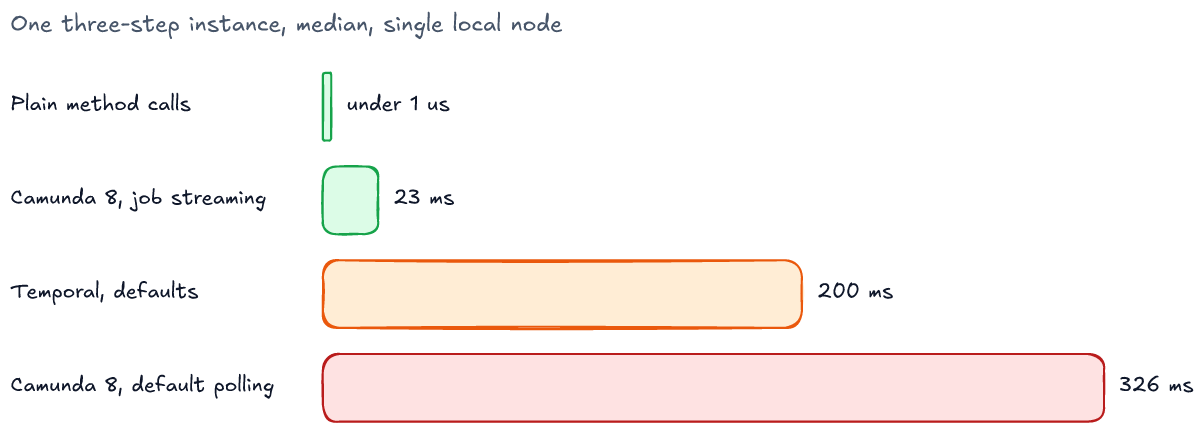
Each step now crosses a network and a durable log. This is what one three-step instance with empty steps cost, on one local node in Docker on my laptop, measured over 200 runs after 50 warm-up runs:
| setup | p50 | p95 |
|---|---|---|
| Plain method calls | under 1 µs | under 1 µs |
Camunda 8, streamEnabled(true) | 23 ms | 37 ms |
| Temporal, defaults | 200 ms | 206 ms |
| Camunda 8, defaults | 326 ms | 339 ms |
These are from the run committed as test-results.log. Across my eight runs, streaming ranged from 17 to 24 ms and polling from 324 to 328 ms. The practical finding is the gap between the Camunda rows, which is one flag. Job streaming is off by default and the documentation recommends it. Do not read more than that into these numbers. It is one node, on a development database, and I did not measure throughput or a cluster. Temporal's suspiciously round 200 ms is not a fixed delay: with 0, 1, 3, 6 and 10 empty steps it took 50, 99, 200, 350 and 550 ms, so about 50 ms per step on this development server. I did not chase the cause or try to tune it. The order of magnitude is the point: tens to hundreds of milliseconds for steps that are about to wait days is nothing, and on a request path where a user is waiting it is a real cost.
Orchestration or choreography?
The usual comparison says events are decoupled and orchestrators are a single point of failure. I built the event version too, with three services on RabbitMQ, durable queues, publisher confirms and manual acknowledgements (all explained in my RabbitMQ tutorial), to see what it gets wrong. The saga pattern draws the same line: in choreography "each local transaction publishes domain events that trigger local transactions in other services", and in orchestration "an orchestrator (object) tells the participants what local transactions to execute".
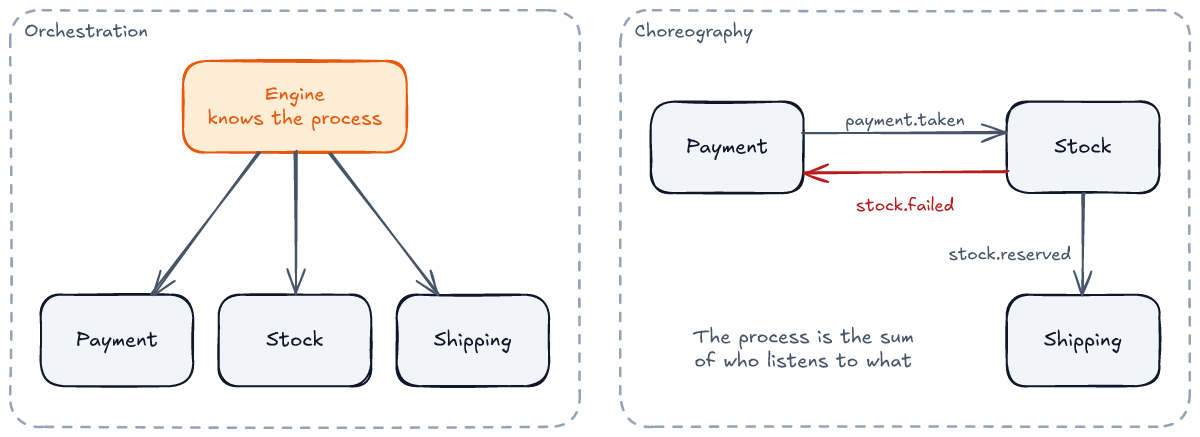
The honest result is that choreography did not lose on resilience. A payment service killed between charging and acknowledging got its message redelivered, and the order carried on. It charged twice as well, for the same reason as every other design here. The difference shows up in the other three properties from the definition:
| choreography | orchestration | |
|---|---|---|
| Survives a worker crash | yes | yes |
| Duplicates after that crash | yes, unless idempotent | yes, unless idempotent |
| Where the order of steps lives | in the bindings of every service | in one definition |
| A stuck order | a count on a queue | a named step, with an error |
| Compensation | another listener, in another service | a path in the definition |
| Waiting three days, or for a person | you build it | built in |
| Coupling | services know events | the engine knows every step |
| When the central piece is down | broker down: nothing moves | engine down: nothing moves |
The stuck-order row is a test. With the shipping consumer stopped, the only trace of order C-4 in the broker is getMessageCount() == 1 on one queue. Nothing fails and nothing is red. To answer "where is C-4?" you would have to build a read model that listens to every event, which is a first step towards writing the engine after all. Distributed tracing helps with the path an order took, but not with noticing that a step should have happened and did not.
The last row is the one the usual comparison skips. An engine is a critical dependency, and so is a broker. Choreography moves that risk, and does not remove it. Choreography is still the right call when the steps really are independent reactions: when one service announces something and others may care, and nobody needs to know the whole story. That describes a lot of real events, and a process engine there would only add a coordinator with nothing to coordinate. Most large systems I would expect to use both: orchestration inside a business capability, where one team owns the process, and events between capabilities, where nobody should own the whole.
Model or code: Camunda and Temporal
Engines split into two families. On Camunda, as on other BPMN engines, the process is a model. On Temporal the process is ordinary code, and the engine makes it durable:
// src/main/java/com/wolinski/orchestration/temporal/OrderWorkflowImpl.java
public String place(String orderId, long deliveryDeadlineSeconds, boolean outOfStock) {
    activities.charge(orderId);
    try {
        activities.reserve(orderId, outOfStock);
    } catch (ActivityFailure failure) {
        if (failure.getCause() instanceof ApplicationFailure cause && "OUT_OF_STOCK".equals(cause.getType())) {
            activities.refund(orderId);
            return "cancelled";
        }
        throw failure;
    }
    activities.ship(orderId);
    if (Workflow.await(Duration.ofSeconds(deliveryDeadlineSeconds), () -> delivered)) {
        return "delivered";
    }
    activities.chase(orderId);
    return "chased";
}
That method can wait for days, across restarts, in an ordinary-looking call. It works by replay: after a crash, the worker runs the method again from the top, and the SDK answers each step from the recorded history instead of executing it. It is a pleasure to write, and it is why finished steps did not repeat in my test.
It is not quite ordinary code, though. Temporal's docs say "A Workflow Definition must be deterministic to support replay", so no system clock, no plain random numbers and no threads of your own, and anything touching the outside world goes in an activity. History also has a limit: by its docs, an execution is terminated when it "exceeds 51,200 Events", so a process that loops for a long time has to restart itself with Continue-As-New, which I did not test.
This table comes from their documentation and my opinion; the tests above cover crashes and versions, not these rows.
| Camunda 8 | Temporal | |
|---|---|---|
| You write | A BPMN model, plus workers | Java, Go, Python and others, plus activities |
| Who can read the process | Also people who do not code | Developers |
| People in the process | User tasks are built in | You build them with signals |
| Loops and conditions | What the model and its expressions allow | The whole language |
| Testing a process | A process test library | A test environment, with time skipping |
| Engine licence for production | Paid | MIT server; you operate it, or pay for their cloud |
That licence row is worth reading before you get attached. Camunda's licensing page states: "To use the software in production, purchase the Camunda Self-Managed Enterprise Edition." The non-production terms cover development, testing and evaluation, as I read them, which is what this repository does, and the Java client is Apache 2.0. Temporal's server is MIT and its SDK is Apache 2.0. If you want open-source BPMN, Flowable is Apache 2.0, though I did not test it. All of these were as stated on November 4, 2026, and this is not legal advice.
A puzzle: the release that breaks nothing new
The business wants a fraud check before the charge. You add one line to the Temporal workflow, and deploy.
// src/main/java/com/wolinski/orchestration/temporal/ReorderedWorkflowImpl.java
public String place(String orderId, long deliveryDeadlineSeconds, boolean outOfStock) {
    activities.fraudCheck(orderId);
    activities.charge(orderId);
    try {
        activities.reserve(orderId, outOfStock);
    } catch (ActivityFailure failure) {
        if (failure.getCause() instanceof ApplicationFailure cause && "OUT_OF_STOCK".equals(cause.getType())) {
            activities.refund(orderId);
            return "cancelled";
        }
        throw failure;
    }
    activities.ship(orderId);
    if (Workflow.await(Duration.ofSeconds(deliveryDeadlineSeconds), () -> delivered)) {
        return "delivered";
    }
    activities.chase(orderId);
    return "chased";
}
The build is green. New orders run the fraud check and ship. No order is marked as failed, and describe() on each of them says RUNNING. A few days later, support asks why orders from last week never closed, although the carrier has confirmed delivery. What happened?
The answer
Orders already waiting for delivery got stuck, and they are stuck in a way that looks healthy.
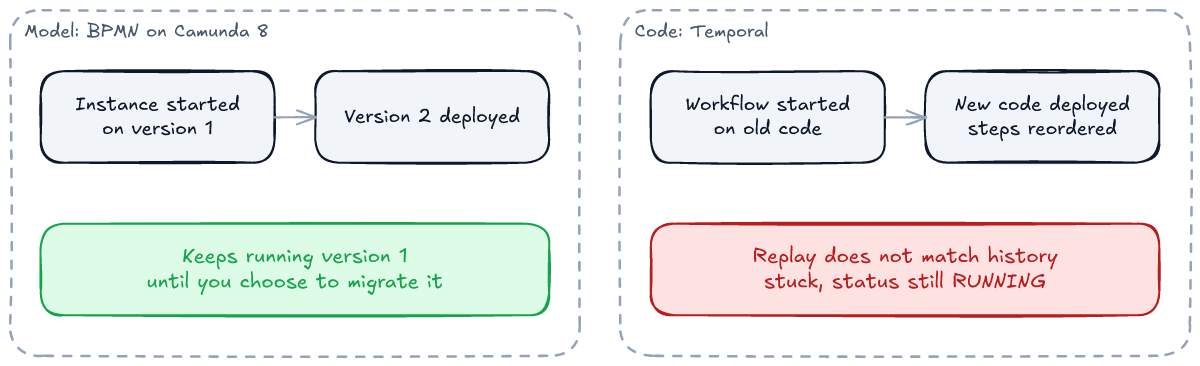
When the delivery signal arrives, a worker replays the method against the order's history to rebuild its state. The new code's first step is fraudCheck. The history's first step is charge. They do not match, so the SDK refuses to continue. In the test the history shows WORKFLOW_TASK_FAILED with cause NON_DETERMINISTIC_ERROR, while the status stays RUNNING and the fraud check never runs for that order. Temporal keeps retrying, in the hope that a fixed worker appears, and that is deliberate: nothing is lost. Deploying the old code brings the order back to life and it completes, which the test also confirms. But you have to know to look. By the fourth property in my own definition, this is a weak spot in Temporal: the answer exists, in the history, but the question "is it stuck?" takes more than a look at the status.
The fix is a version marker, which records in the history which path this execution took:
// src/main/java/com/wolinski/orchestration/temporal/PatchedWorkflowImpl.java
public String place(String orderId, long deliveryDeadlineSeconds, boolean outOfStock) {
    if (1 == Workflow.getVersion("fraud-check", Workflow.DEFAULT_VERSION, 1)) {
        activities.fraudCheck(orderId);
    }
    activities.charge(orderId);
    try {
        activities.reserve(orderId, outOfStock);
    } catch (ActivityFailure failure) {
        if (failure.getCause() instanceof ApplicationFailure cause && "OUT_OF_STOCK".equals(cause.getType())) {
            activities.refund(orderId);
            return "cancelled";
        }
        throw failure;
    }
    activities.ship(orderId);
    if (Workflow.await(Duration.ofSeconds(deliveryDeadlineSeconds), () -> delivered)) {
        return "delivered";
    }
    activities.chase(orderId);
    return "chased";
}
With that, the old order completes with no fraud check and a new one gets it. Better still, you can catch the mistake before deploying. Temporal's SDK can replay a saved history against new code, and that fails the build on the reordered version and passes on the patched one:
// src/test/java/com/wolinski/orchestration/TemporalTest.java
WorkflowReplayer.replayWorkflowExecution(history, OrderWorkflowImpl.class);
WorkflowReplayer.replayWorkflowExecution(history, PatchedWorkflowImpl.class);
assertThatThrownBy(() -> WorkflowReplayer.replayWorkflowExecution(history, ReorderedWorkflowImpl.class))
        .isInstanceOf(RuntimeException.class);
For that to protect you, the histories have to come from real running executions, so saving a sample of them belongs in your release process. Temporal's Java versioning guide also covers a newer alternative based on worker versions, which I did not test.
The same release on Camunda behaves differently, because deploying a new model creates a new version and leaves running instances alone. In the test, an instance started on version 1 goes straight from approval to payment after version 2 is deployed, while a new one goes through the added fraud step. A third, moved explicitly with newMigrateProcessInstanceCommand, takes the new path too, and migration has limits of its own that I did not explore. The catch runs the other way: if version 1 had a bug, every running instance keeps it until someone migrates them. Neither approach makes this free. Any system with processes that run for weeks has this problem, and it is a real part of the cost of having them.
When to reach for it
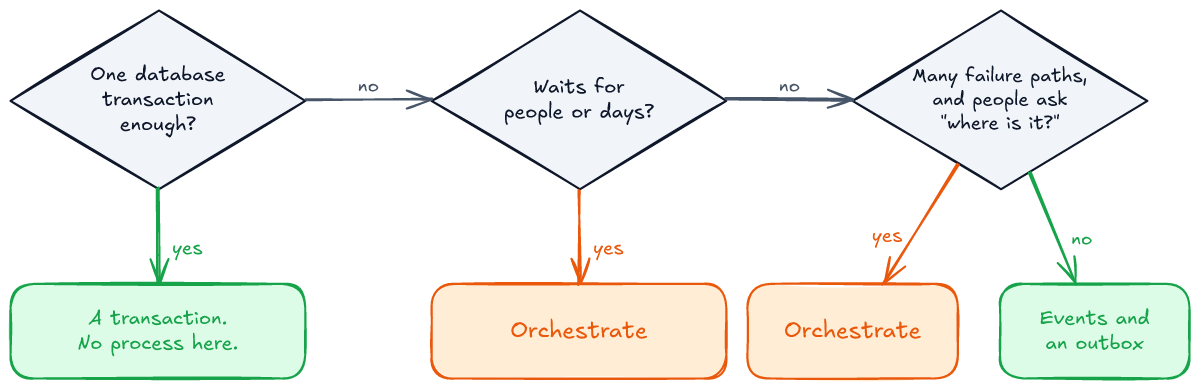
- Do not orchestrate one transaction. If everything fits in one database commit, you have no process, and an engine only adds a network hop and a place to fail.
- Do not orchestrate a request path by reflex. A user waiting on three synchronous calls does not gain much from durability, and pays the latency above.
- Do orchestrate waiting, once there is enough of it. Timers and people are what status columns handle worst, and engines handle best. One process with one timer can still be a status column and a scheduled job.
- Do orchestrate when the failure paths outnumber the happy path, and when support keeps asking where things are.
- Budget for what remains yours. Idempotent steps, a safe start, retry policies, compensations, versioning, keeping data out of the engine, alerts on stuck cases, a definition tied to one engine, and running a critical piece of infrastructure.
Scope and how this was checked
./run.sh runs 33 tests on Temurin JDK 25 in a Docker image pinned by digest, against Camunda 8.10.8, Temporal server 1.32.2 and RabbitMQ 4.4.0, also pinned, using Camunda client 8.10.8 and Temporal SDK 1.40.0. Workers that have to crash run in their own JVM and end in Runtime.halt, and engines are stopped with docker kill, so these are real crashes rather than exceptions. A file standing in for the outside world records each side effect, and the assertions read that file.
The limits matter. Each engine is a single node on a development database: H2 for Camunda and SQLite for Temporal's development server. Neither is what their vendors support for production, and I did not test clustering, failover, upgrades of the engine itself or real load. The latency figures come from one laptop. Having both SDKs in one JVM required forcing a single gRPC version, which a real service would not need. And the definition at the top is mine. Vendors draw the line elsewhere, and Temporal itself uses "durable execution" rather than this term.